Papio-software: native MorphOS applications by Yannick

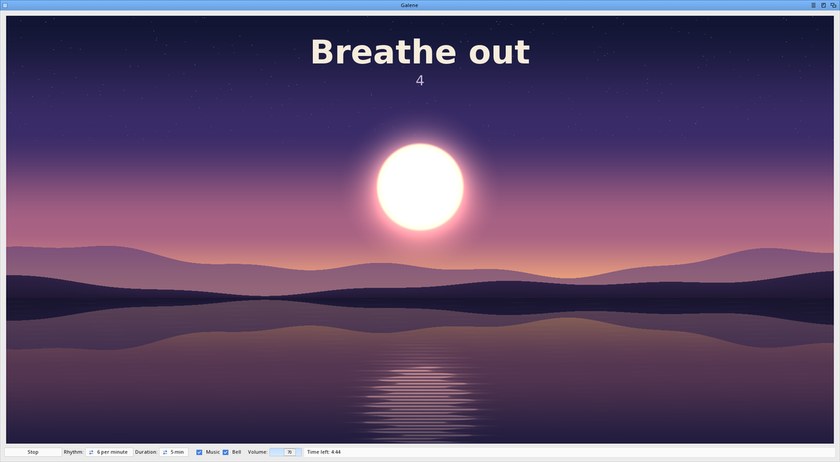
Galene breathing guide for MorphOS

If you run MorphOS, chances are you have already bumped into something made by Papio-software. Behind that name is Yannick, a French developer who writes native MorphOS software in C with MUI, from office suites to an Amiga emulator. Time to meet the man and his software.

The man behind Papio-software

Yannick has been passionate about computers since the Amiga days. When he discovered MorphOS, a lightweight, fast and elegant operating system for PowerPC, it was love at first sight. He builds all his applications natively in C because he believes the platform deserves software that matches its elegance and speed.

His goal is simple: keep the MorphOS ecosystem alive, useful and enjoyable. With over 122 contributions on MorphOS-Storage, including original applications, game ports and utilities, he is one of its most productive developers.

Developed with Claude

Yannick does not build all of this alone: he develops his software with the help of Claude, the AI assistant from Anthropic. It helps him write and refine the C and MUI code, which is one reason a single developer can keep so many applications and ports moving at the same time.

The four Papio suites

The flagship products are four complete, native suites. Every program in them can be tried as a demo, and registering unlocks the full version.

  • Papio-Office (Stylos, Sigma, Diapos, NoPaper, IPP-PrintScan, Cardex): word processing, spreadsheets, presentations and documents.
  • Papio-Design (Folios, Graphos, Momento, Pixelios): page layout, vector drawing, photos and pixel painting.
  • Papio-Music (Composito, Resonance, Amplitude, Pulsio): scores, piano and synthesizer, sound editing, drum machine and sequencer.
  • Papio-3D (Modulo, Forma, Stratos): 3D modelling and 3D printing.

Lorraine: an Amiga emulator written from scratch
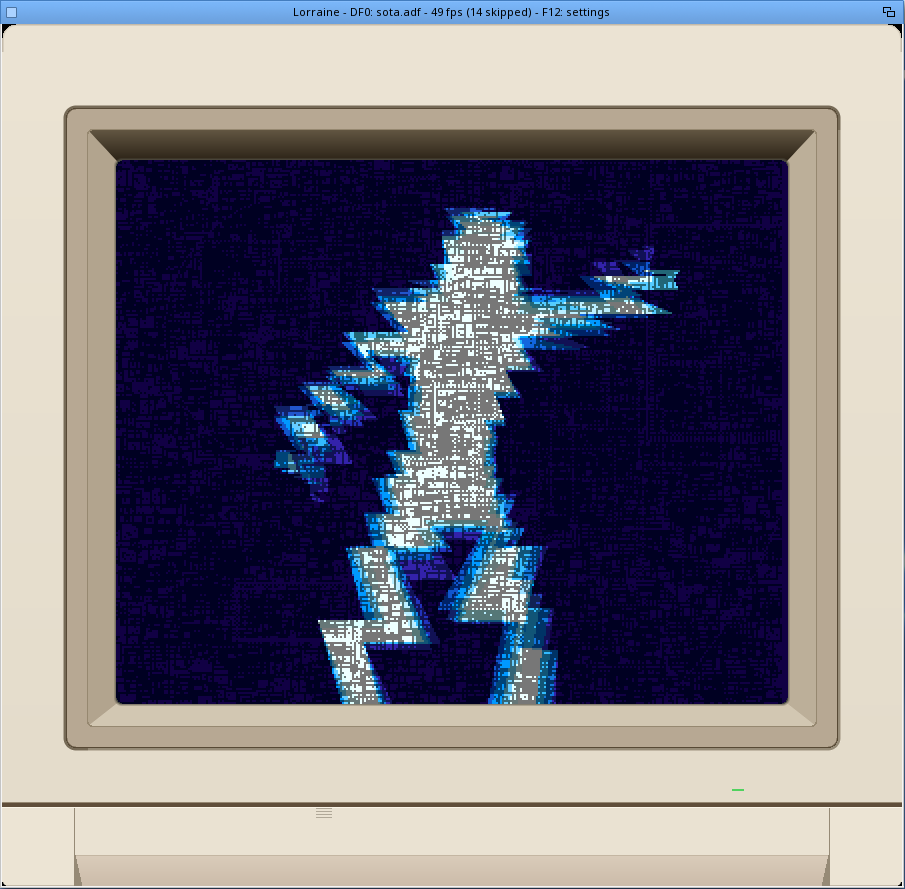
Lorraine Amiga emulator for MorphOS
Lorraine running an Amiga demo

Lorraine is an Amiga emulator developed from scratch for MorphOS and designed for speed on PowerPC: 50 frames per second on a PowerBook G4 and on a Mirari. It emulates a PAL Amiga 500 (68000, OCS/ECS) and an Amiga 1200 (68EC020 to 68060, AGA), starts from your own Kickstart ROM and disk images, and supports ADF, DMS and IPF images, WHDLoad, hard disk files, CD32 discs and a game library with 1,737 screenshots.

Everyday tools
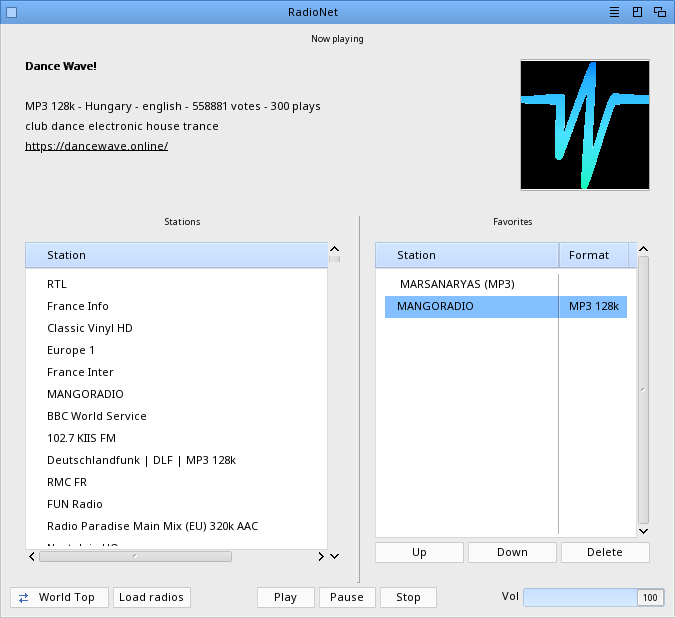
RadioNet internet radio player for MorphOS
RadioNet with its station list and Now Playing panel
  • RadioNet: a free native internet radio player using the RadioBrowser directory. MP3, OGG and AAC play internally, including HE-AAC through Fraunhofer FDK-AAC and playlist stations such as the BBC channels.
  • RSS-Reader: RSS and Atom reader with up to 512 feeds and built-in podcast playback.
  • MiniPage: a reader for text-based pages: Markdown, Gemini and plain HTML, with no JavaScript.
  • Iconos: an icon and pixel art editor with 32-bit RGBA editing and zoom up to 32x.
  • Galene: a heart coherence breathing guide with a glowing sun above a lake, soft live music and a small bell.
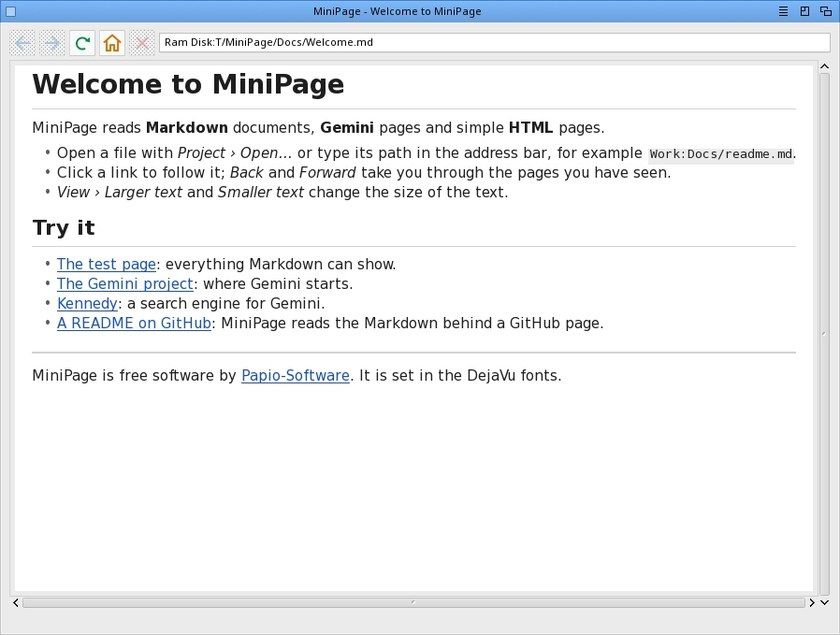
MiniPage reader for MorphOS
MiniPage showing a text-based page

For users and developers

Easy2Install for MorphOS
Easy2Install browsing MorphOS-Storage
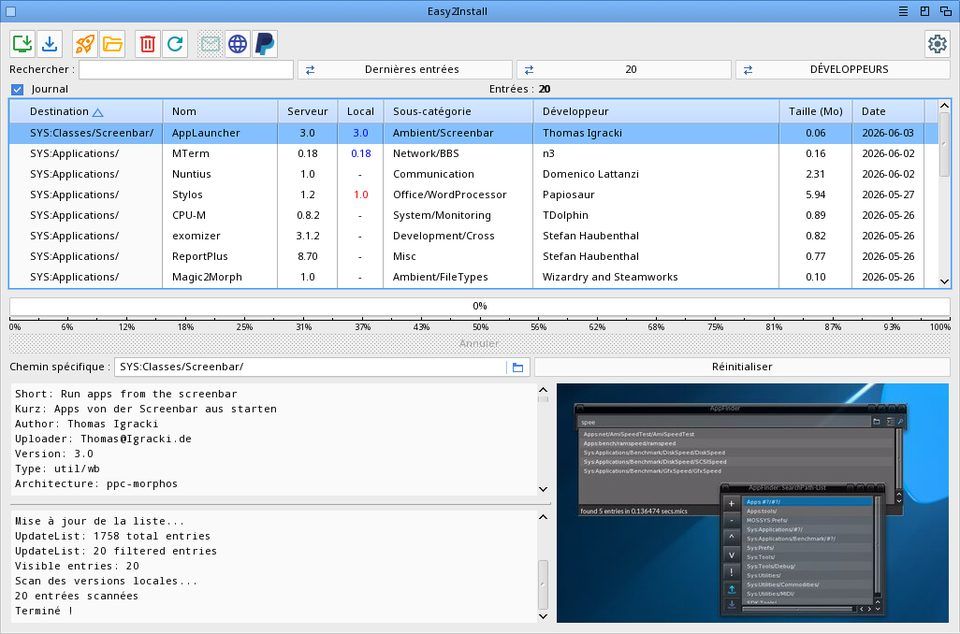
  • Easy2Install: connects directly to MorphOS-Storage to browse, download, install, update and uninstall software in a few clicks.
  • SDK-Explorer: a three-panel browser for the MorphOS SDK autodocs, examples, headers and FD files, with syntax highlighting.

Projects in progress

There is plenty more on the way:

  • Hemera: a calendar with week, month and six-month views, iCalendar support and a 16-day weather forecast.
  • Easy2Clean: a system integrity checker that compares SYS: and MOSSYS: with a clean MorphOS install and quarantines unknown files.
  • EasyFiles: a dual-panel file manager.
  • BluePill: a native Matrix client with end-to-end encryption.
  • MorphDC: a Dreamcast emulator, ported from nullDC. A first game already runs.

Game and emulator ports

Yannick is also bringing a long list of games and emulators to MorphOS, among them VICE 3.10, Morrowind, Jagged Alliance 2, FreeSpace 2, Arcanum, OpenTESArena, Sonic Robo Blast 2, Dungeon Crawl Stone Soup, Abuse, Fade to Black, Colobot, Hi-Octane, Oolite, VDrift, Lix, H-Craft Championship, Friking Shark, Little Big Adventure 2 and the Zod Engine. The ports are free software. Donors of 1 euro per project join the beta test, and finished ports are released for free on MorphOS-Storage. Games that need original data are supplied as the engine only, so you provide the files from a copy you own.

Get it

Everything is available on the Papio-software website and on MorphOS-Storage. Got an idea for a program or a port? Yannick welcomes your suggestions.
MBlue 1.0 – Bluetooth stack for MorphOS

MBlue 1.0 is a Bluetooth stack for MorphOS 3.21 or higher.

Download MBlue from MorphOS Storage

What it does

  • Keyboards and mice, classic and LE (a phone too).
  • Speakers and headphones as AHI modes; their buttons are media keys.
  • Headset microphone as an AHI recording input.
  • Battery level, files to and from phones.
  • Preferences and a screen bar icon, in 9 languages.

Hardware

  • USB dongles with a Realtek chip (firmware included; RTL8761B: TP-Link UB500…), a CSR chip (CSR8510: TP-Link UB400…) or an old Broadcom (BCM2046).
  • Built-in Bluetooth of the iMac G5, Power Mac G5 and PowerBook G4.
  • Not yet: Intel, MediaTek, Qualcomm/Atheros, recent Broadcom. Headset dongles (Poly BT600, Jabra Link) are sound cards, not radios.

Install

Double-click Install, reboot, plug the dongle, open SYS:Prefs/MBlue. To uninstall: Install again, choose Uninstall.

Use

  • Pair: device in pairing mode, "Add a device…", choose it, Pair.
  • Screen bar icon: grey = no radio, blue = ready, green dot = connected.
  • A player already playing keeps its old output: restart it once the speaker is connected.
  • Received files go to "RAM:Bluetooth received" (General tab).
  • Updates: checked once a day, installed only if you say yes.

Shell: BTCtrl (scan, pair, connect…), BTDevLister (list), BTErrorLog (log), BTRecord (microphone to WAV), BTSend (send files), MBlueUpdate.

Limitations

SBC only (about 200 ms of latency). Most headsets pause the music while the microphone records; no phone calls. No game controllers yet.

History

1.0 (18.11.2026) – First public release, after 20 beta versions. All versions: Docs/CHANGELOG.txt.

Licences

Core (aros-bluzing, Jaime Dias): MIT. The rest: AROS Public License 1.1 (Licences drawer). Realtek firmware: redistributable.

Port to MorphOS: BeWorld. Thanks to the MorphOS Team and the testers.

MorphOS 3.20 and 3.21 released

MorphOS loves Mirari

The MorphOS development team has been busy: MorphOS 3.20 arrived on 30 May 2026, closely followed by MorphOS 3.21 on 7 November 2026. Here is a quick overview of both releases.

MorphOS 3.20 – the Mirari release

MorphOS 3.20 is a major step forward and introduces support for the new Mirari architecture, together with dedicated system components, drivers, thermal management support and updated networking functionality.

  • Graphics: Radeon support has been expanded to more GPU families, with better HDMI, DVI and DisplayPort handling, improved multi-monitor support and better 3D compatibility. TinyGL and the Radeon drivers received major updates for faster, more stable rendering.
  • Filesystems: SFS2 support across the OS allows files larger than 4GB and partitions up to 2TB, with nanosecond timestamps and dates beyond the year 2038.
  • Ambient: improved icon handling, search, drag-and-drop, external panel support and multimedia format handling.
  • New utilities: DriveImager, MirrorBackup, SMARTDoctor, OFArc, OFHTTP, OFHash, OFDNS, Replace and Automator for scripting and controlling MUI applications.
  • Iris 1.53 with the new Contacts companion application for CalDAV-based address books, plus many FlowStudio improvements.
  • Networking: OpenSSH 10.3p1, TLS 1.3 in RDesktop, SMB2 improvements and better USB, audio and multimedia stability.

On top of that comes a very large number of bug fixes, performance improvements and usability refinements. A matching MorphOS SDK 3.20 (May 2026) was released as well, featuring GCC 15.2.0, Python 3.14.4 and 64-bit time_t, off_t and fpos_t in ixemul and libnix.

MorphOS 3.21 – stability, security and performance

Released on 7 November 2026, MorphOS 3.21 focuses on stability, security and performance, and adds a few new components:

  • BasicWorks: a new office suite made up of CellBasics and PageBasics, which loads and saves Microsoft Office and OpenOffice documents.
  • NVMEMount: an auto-mounter for booting from and mounting NVMe partitions, plus the new Marbles and Cyber 3D blankers.
  • Graphics: a faster Radeon driver on cards with little video memory, quicker TinyGL texture copies, hardware accelerated antialiased text in TTEngine and much faster colour SVG glyph rendering in Cairo.
  • Wireless: a substantially reworked Bcm43xx driver with automatic transmit rate selection, updated firmware and many connection fixes.
  • Hotkeys: PowerBook and iMac hotkeys are now fully configurable.
  • Updated libraries: OpenSSL 4.1.0, FreeType 2.15.0, HarfBuzz 15.0.0, ObjFW 1.5.7 and OpenSSH 10.6p1 in RemoteShell.

New users are strongly advised to read the installation and troubleshooting guides first; existing users can upgrade via the familiar procedure. Both releases are available in the files section of the MorphOS website, where you will also find the full release notes.

Mirari PowerPC Motherboard: 100-Board Production Run Delayed

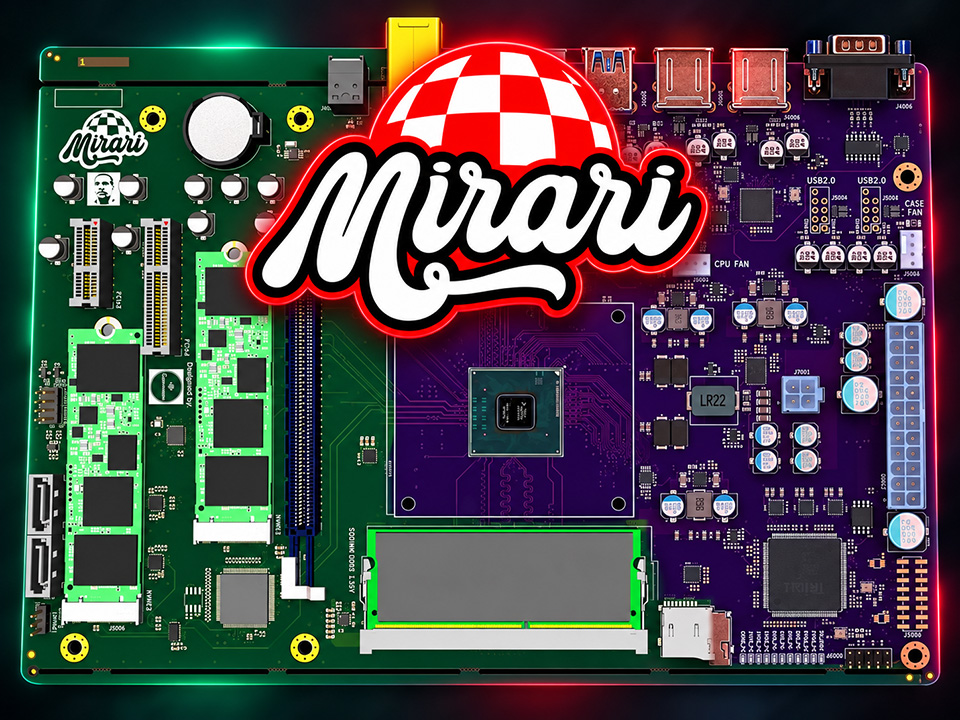
Mirari PowerPC motherboard with the Mirari logo
The Mirari PowerPC motherboard is heading for its biggest production run yet, and according to a headline on The Oasis BBS, that run of 100 new boards has now been held up by a production delay. Here is some background on what Mirari is and why those 100 boards matter.

What is Mirari?

Mirari started life in 2024 as a KiCad motherboard design. Since then the developers have worked through the problems you would expect from completely new hardware: clock issues, PCI Express fixes, firmware work, driver development and plenty of testing. The result is a PowerPC system that is much closer to a complete desktop platform than an engineering board that happens to boot.

From five prototypes to 100 boards

The first production batch was just five boards, built to answer basic questions: does the hardware start, does the firmware initialise everything, will Linux boot, and do PCI Express, storage and networking work? An early oscillator problem stopped several important clock signals from behaving, but once it was fixed, U-Boot and Linux came up quickly. The Proto 2 run is on a different scale. One hundred boards are being prepared, with processors sourced from the United States and assembly planned in the Netherlands. It will not turn Mirari into a mass-produced PC, but building, testing and shipping 100 consistent machines needs a much tighter production process than five engineering samples did.

Modern hardware around a PowerPC processor

  • NVMe storage, SATA, USB 3.0, Ethernet and PCI Express
  • Up to 8 GB of memory via DDR SO-DIMM modules
  • Several PowerPC Linux distributions already run from an NVMe drive connected directly to the board
Development has not been completely smooth. The PCIe x1 slot needed a hardware correction during testing, and an earlier Proto 2 batch arrived without some components fitted because the parts were not available, so items like the PCIe x16 connector and USB headers had to be added by hand. That is what prototype work looks like.

Software support

MorphOS 3.20 adds support for the Mirari architecture, including drivers for networking, storage and temperature control, and it can install to and boot from an NVMe SSD.

About the delay

The Oasis BBS reports that a production delay is holding up the 100 new motherboards. I have not been able to read that article in full, so I cannot say what caused the delay or how long it is expected to last. For the details, read the original report.

Sources

Amiga/40th is almost starting. Check out the Youtube stream!

As posted on the Amiga/40th website.

It’s been ten years since the highly successful Amiga 30th in Mountain View, California.  Over the last ten years, we have seen an incredible vibrancy in the global Amiga community.  With projects like the Vampire, Emu68K, and Amiga OS 3.2 combined with AROS, AmigaOS 4 and MorphOS, never has there been so much activity and energy for the Commodore Amiga and its many derivatives.

2025 marks the 40th anniversary of the Commodore Amiga 1000 release.   The AMIGA/040th Silicon Valley will be the central theme at the amazing VCF West show.  Happening at the Computer History Museum in Mountain View, CA, we will offer all attendees a unique area on the show floor. In this area, you will explore the Saga of the Amiga Computer–before Commodore, during its golden era, and beyond…  Expect to see unique historical artifacts from the personal collection of Dale Luck, the latest Amiga Community innovations like AmigaOS 3.2 and OS 4, alongside groundbreaking hardware projects such as Emu68k, and PiStorm.

Watch the Live Event of Friday Evening here!

Super Star Blast by EntwicklerX Released

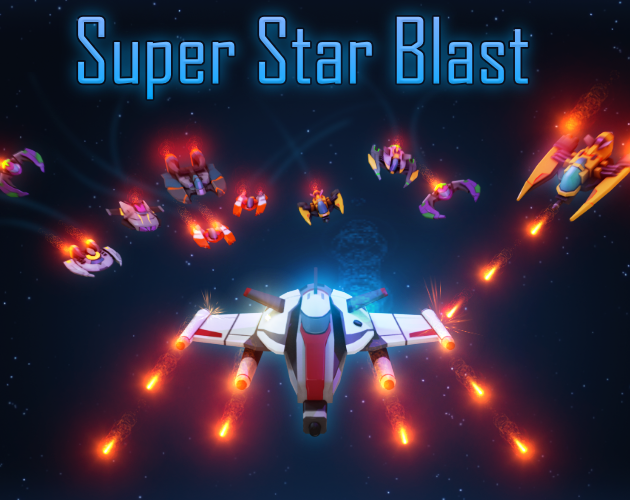
Super Star Blast is a space shooter game with challenging levels of increasing difficulty. All enemies must be shot down to finish a level and go to the next one. A scanner around the player tells roughly where the enemies are located. The player ship can fly forwards to attack and backwards to fight during the retreat against the opponents. After clearing a level you can purchase equipment to boost the ship, as well as extra shields and firepower or more ships.

In local multiplayer mode, up to 4 players can fight together trough the levels (campaign mode) or can get each other in a battle (competition mode).Features:Massive challenging levels of increasing difficultyenemies with unique flying and fire characteristicsUpgrade center (agility, fire power, shield, ships)Single player campaign2 – 4 player coop mode (split screen)Simple and clean 3D space graphics

AmigaOS: Quality and performance Settings

AmigaOS:  Warp3D Nova / OpenGLES Support (required!)

AmigaOS4 information:Hardware

Requirements:AmigaOS 4.1 F.E. Computer with Warp3D Nova/OpenGLES compatible graphics card Because of the many different configurations, it is difficult to cover all problems. Just send us an email to mail@entwickler-x.de and we will try to fix bugs. Also play with the quality and performance settings to adapt the game to your hardware. The “FPS” setting shows you the current frame rate. In the ToolTypes you can also activate your own screen mode. If the setting is put in brackets, the Workbench resolution is used

Game Website:https://entwickler-x.de/super-star-blast

Source: Super Star Blast by EntwicklerX

Alkmaar Amiga Meetup 2024: A Next-Gen Review!

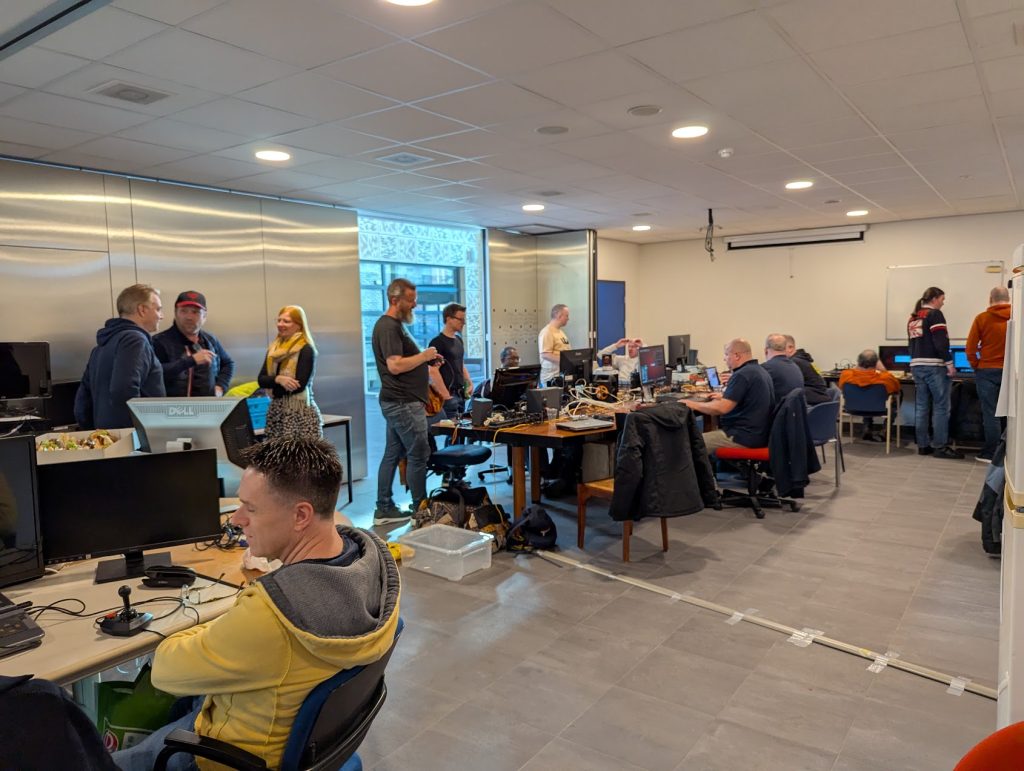
The Alkmaar Amiga Meetup on November 30th, 2024 proved once again that the Amiga community is alive and kicking, with a strong focus on the future! Organized by the ever-enthusiastic Paul Koster of Amigascene.nl, the event drew in Amiga fans from all over the Netherlands and even some dedicated German “Amigans.”

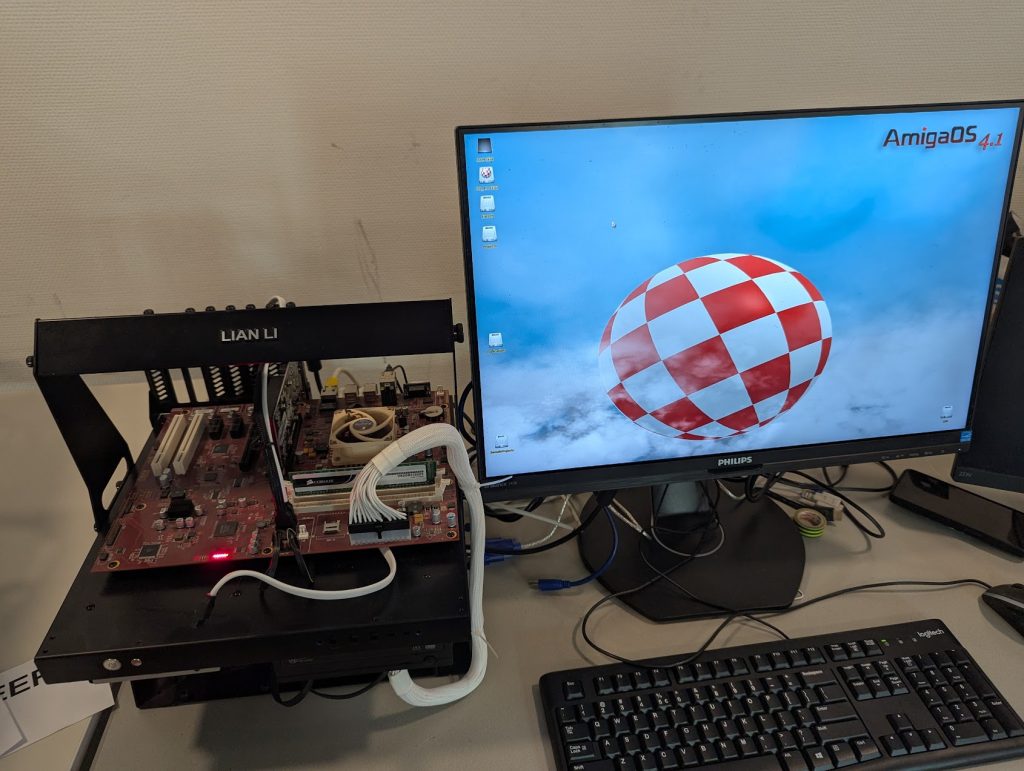
This year’s theme, “Amiga Next-Gen,” put the spotlight on the exciting developments pushing the platform forward. Attendees were treated to a showcase of AmigaOne X5000 machines running AmigaOS 4, with prominent community members like @geennaam (creator of the Next-Gen HD Audio drivers), @skateman, and @PaulKoster demonstrating their impressive capabilities. @oldfart bravely brought his open-case X5000, which unfortunately suffered some boot-up hiccups. But in true Amiga community spirit, fellow enthusiasts jumped in to help, successfully resurrecting the machine!

 @skateman with his dual-GPU equipped X5000, showcasing the versatility of the platform by running MorphOS, Linux, and AmigaOS. It was a testament to the Amiga’s enduring adaptability and the dedication of its community.

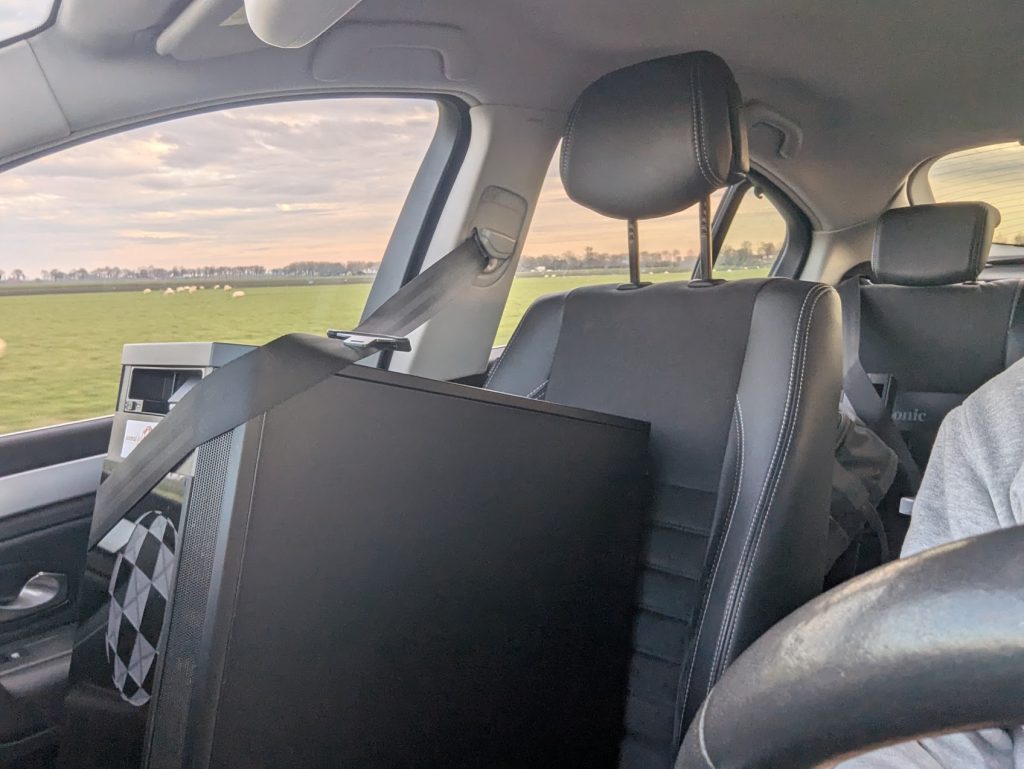
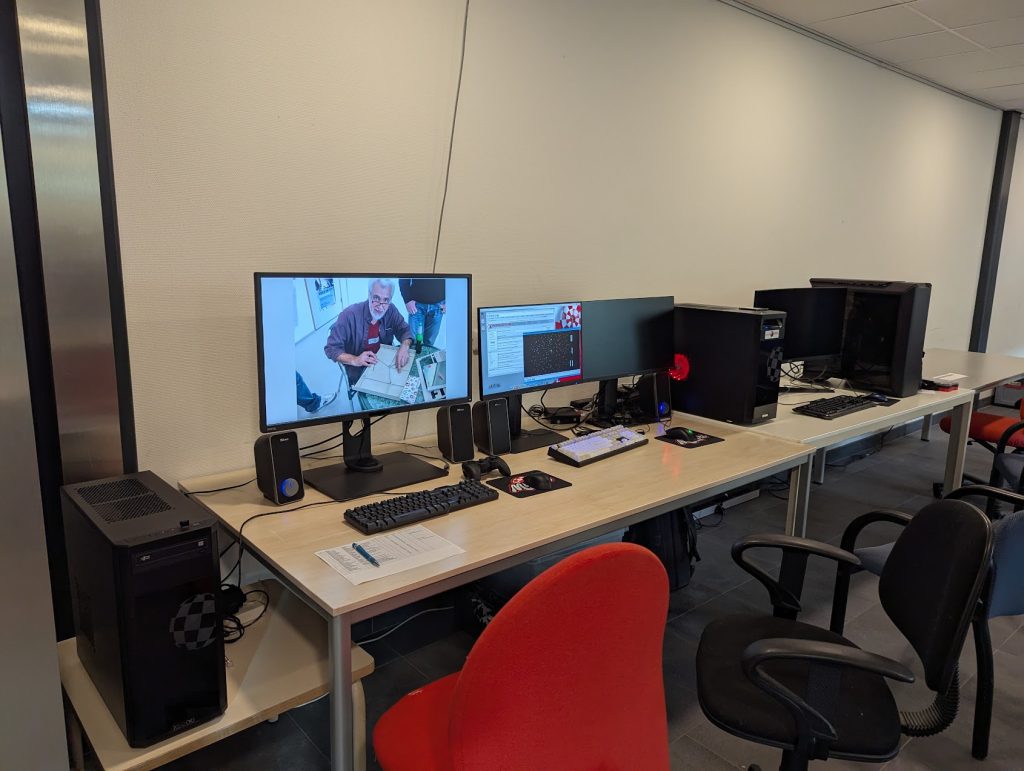
Beyond the impressive hardware, the meetup provided a fantastic opportunity for Amigans to connect, share their passion, and enjoy the friendly atmosphere. Luxury sandwiches, hot snacks, and a steady flow of drinks kept everyone fueled throughout the day. The organizers even provided free parking and trolleys for transporting equipment, ensuring a smooth and convenient experience for all.

The Alkmaar Amiga Meetup 2024 was a resounding success, demonstrating that the Amiga spirit is thriving. With passionate individuals driving innovation and a supportive community fostering collaboration, the future of Amiga looks bright!

rVNCd 1.38: A New Era of Remote AmigaOS4 Control

Empowering Remote Access to Your AmigaOS4 Machine

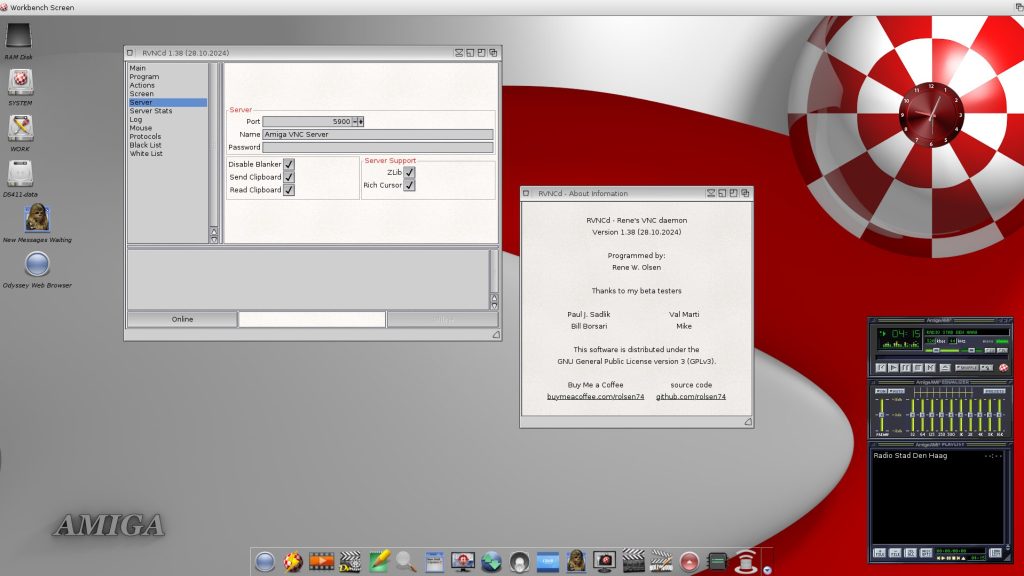
For AmigaOS4 enthusiasts who often find themselves away from their beloved machines, rVNCd 1.38 offers a significant upgrade to remote access capabilities. Developed by the talented Rene W Olsen, this latest version brings a host of enhancements and fixes, further solidifying its position as a must-have tool for remote AmigaOS4 control.

Key Features and Improvements:

  • Enhanced Performance: Experience smoother and more responsive remote sessions, thanks to optimized network communication and rendering.
  • Bug Fixes: A range of critical bug fixes addresses known issues, ensuring a more stable and reliable remote experience.
  • User-Friendly Interface: The intuitive interface remains easy to navigate, making it simple to set up and configure remote access.

How to Get Started:

  1. Download rVNCd 1.38: Acquire the latest version from OS4depot.
  2. Installation: Follow the straightforward installation instructions provided with the software. (Extract the LHA and start the Executable)
  3. Configuration: Customize the rVNCd settings to your preferences, including port number, password, and security options.
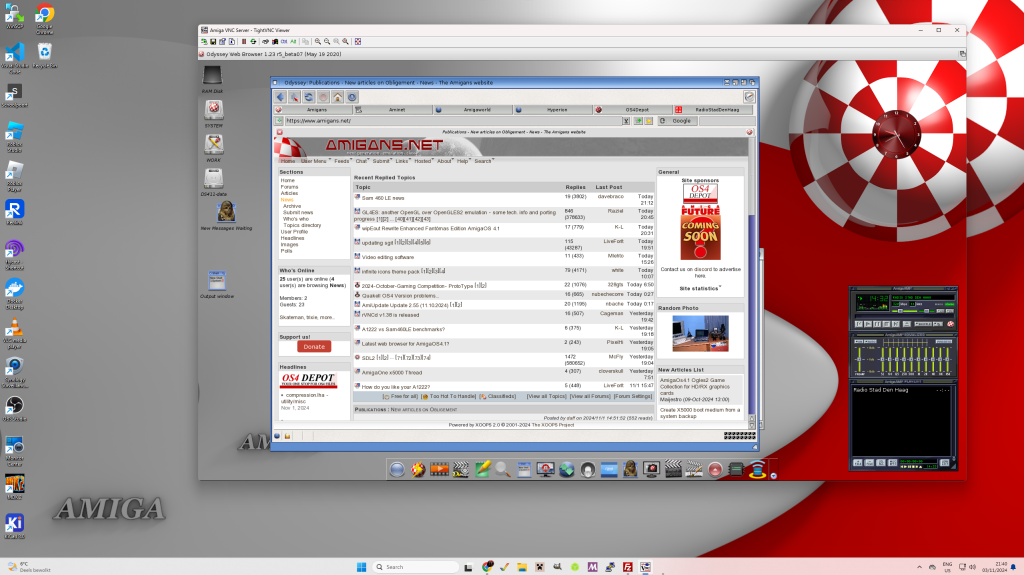
  4. Remote Access: Use a VNC client like TightVNC on your Windows, macOS, or Linux machine to connect to your AmigaOS4 system.

rVNCd 1.38 empowers you to take control of your AmigaOS4 machine from your local LAN or Internet. With its user-friendly interface, it’s the ideal tool for remote access, making your AmigaOS4 experience more flexible and convenient than ever before.

Alkmaar Amiga Meetup 2024!

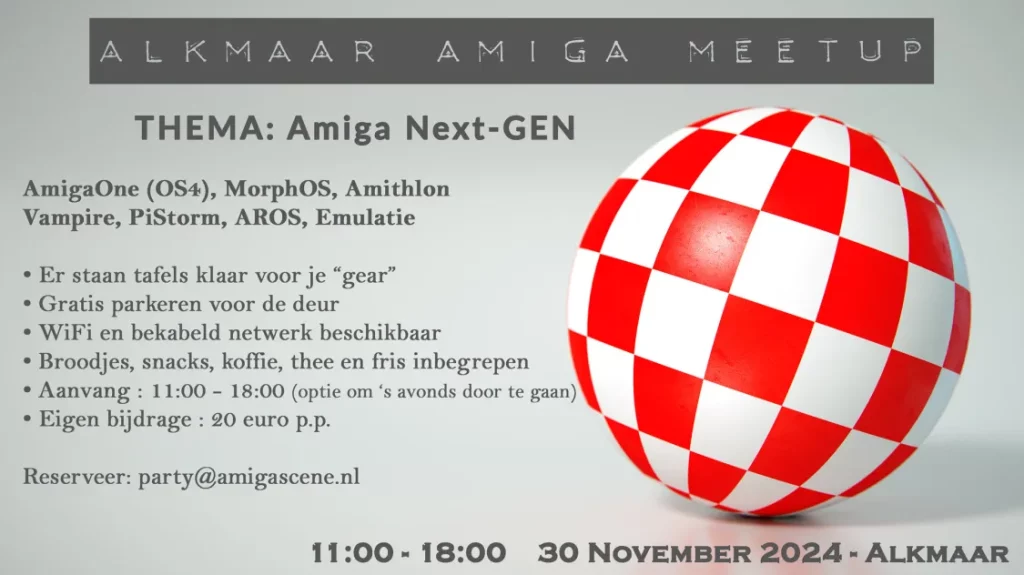
Calling all Amiga enthusiasts! AmigaScene.nl is hosting a special gathering dedicated to the Amiga Next Generation on November 30th in Alkmaar, Netherlands. 🇳🇱

Get ready to delve into the exciting world of what came after the classic Amiga! This event will be a fantastic opportunity to:

  • Explore MorphOS and AmigaOS4: Dive into the latest developments of these powerful Amiga successors.
  • Discover Amithlon: See how this project breathes new Amiga life into x86 hardware.
  • Witness the Power of PiStorm and Vampire: Witness the cutting-edge hardware that’s pushing the boundaries of the Amiga experience.

Bring Your Beloved Amiga!

This isn’t just a spectator event! Feel free to bring your own Amiga hardware and showcase it on one of the reservable tables. It’s a perfect chance to share your passion with fellow Amiga lovers and discover hidden gems from others!

Fueling Your Amiga Spirit! ☕️

The €20 entrance fee covers not only the venue but also keeps you fueled throughout the day with delicious drinks and snacks.

Reserve Your Spot!

Don’t miss out on this exciting Amiga gathering! Head over to AmigaScene.nl for more information and to reserve your spot. (see mail in picture above)

Mark your calendars for November 30th and join the Amiga Next Generation celebration in Alkmaar! 11:00 – 18:00

Spread the word! Share this post with your fellow Amiga enthusiasts and let’s make this a gathering to remember!